WORDS: MIA MEDAKOVIĆ
INTERVIEW: DUŠICA PEJIĆ
PHOTOS: MILAN RADOVANOVIĆ, NEMANJA MARAŠ
Dušica Pejić is an artist who, through her work, explores the dynamic relationship between visual art, movement, and psychological states. Her paintings carry a strong imprint of the unconscious and invite introspection. Through abstraction, she explores deep psychological processes, suggesting that inner tensions open space for growth and for a different understanding of oneself, and that this is where her art begins.
She completed her undergraduate and master’s studies in painting at the Academy of Arts in Novi Sad, and her specialist studies in painting at the Faculty of Fine Arts in Belgrade. She has been recognized as one of the eight most prominent abstract painters in Serbian art after 2000 in a project by art historian and critic Vasilije B. Sujić.
Her works are part of public and private collections in Serbia and abroad, including the Wiener Städtische Art Collection, MONO Company (Budapest), Mandarin Oriental SAVOY (Zurich), Alex Lake (Zurich), Villa Kennedy (Frankfurt), among others.
She has received several awards and acknowledgments for her work, such as an award for collaboration with Art Fest At Doral in Miami (2014), and the Interkomerc Bank Award for Drawing in Belgrade (1998), as well as recognition from the Serbian Academy of Sciences and Arts, Novi Sad Division (2018), and from the Tesla Art Foundation in Belgrade (2017).
Through her pedagogical and artistic work as a professor at the Belgrade Dance Institute, she connects different artistic disciplines, while her own creative practice begins in the personal and unfolds into the universal.
Dušica Pejić is an important representative of contemporary Serbian art, an artist whose artistic practice explores inner conflicts, psychological states, and the relationship between the conscious and the unconscious through gestural and abstract expression.
How would you define your art?
Opposites are what move me in life, and in art as well. I see my art as a strong yet quiet voice of the soul, a voice that simply exists. That quiet persistence, because it is quiet, holds great power. The human being is a polar being. You are an artist of movement, someone who has brought the experience of ballet into dialogue with the canvas. Ballet, like fencing, represents a profound experience and one of my great loves. These are arts that, perhaps above all on a spiritual level, connect deeply with my work in visual art. They meet and merge on an almost archetypal level, through movement, strength, endurance, and courage. Ballet is a matter of attitude, just like art: graceful, seemingly effortless, yet stable and powerful, supported by serious work. That connection exists both spiritually and physically, on the level of movement and on the conceptual plane. Many times it was difficult for me to rationally define the meaning of what I do; everything seemed disconnected. And yet I felt it was essential for me. Everything that truly matters to us, no matter how disconnected it may seem, comes together at a certain moment on a deeper level, like pieces of a soul’s puzzle.
Why is movement — spiritual, physical, and mental, so important to your creation?
Everything we do in life is connected to movement. Movement is life. It is crucial that we move, spiritually, mentally, emotionally, physically, in every way. When we stand still, we do not remain where we are. We regress.
Many times I go to the studio and do not paint. I need to think, to feel. To enter my inner space. That is as important as the act of painting itself. Movement is not only the physical act of painting. Active, not passive, inner movement is more significant than physical activity. If we are in that movement, the work itself moves. My active work on a painting may last a short time, but it is the result of long inner movement.
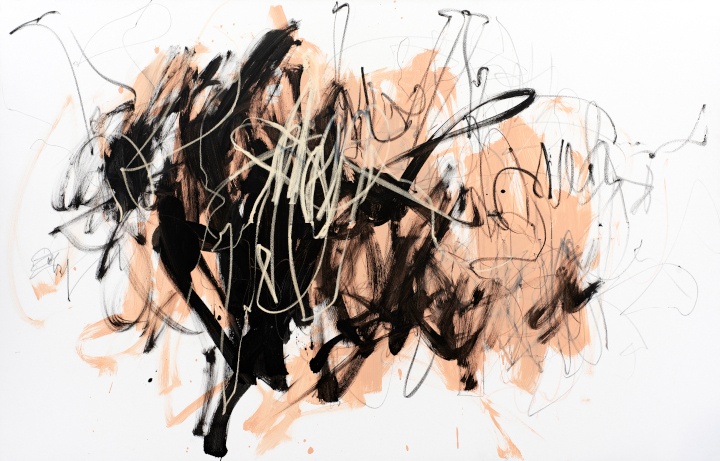
In your work one often senses layers of symbolism and inner landscapes — when did you first encounter Jungian psychology, and how did it shape your artistic language?
My interest in psychology emerged from a need to understand and help myself. More than twenty years ago, I experienced anxiety and panic attacks. At the time it was a difficult experience, but years later I realized it was one of the most important things that happened to me. It questioned my beliefs and brought deep changes to my relationship with myself and with life.
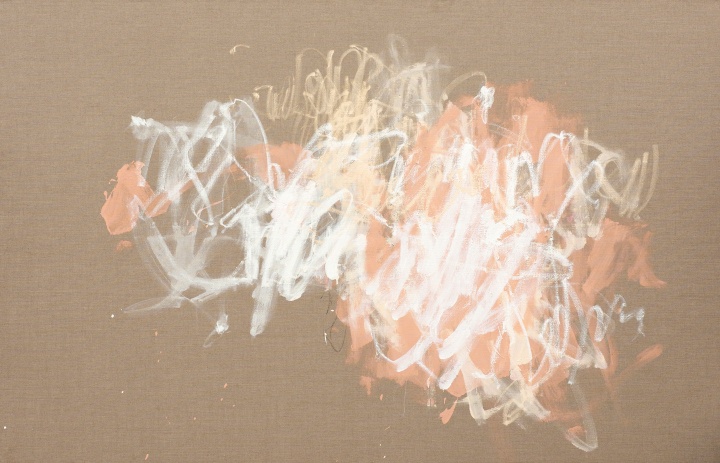
My interest in abstract art existed before that, so psychology naturally continued my creative path. Abstract art, perhaps more than any other, allows direct contact with the unconscious and with the inner space.
Among many authors I have read, Carl Gustav Jung had the deepest impact on me. He is a remarkable thinker, someone who goes into depth, into the vertical axis of the horizontal. There are many intelligent and educated people, but few who are truly wise. Jung is certainly one of them.
Jung believed that symbols are a bridge between the conscious and the unconscious — do you experience painting as a space of that encounter? My paintings are spaces where the conscious and unconscious meet. Where I touch and attempt to grasp a fragment of unconscious content. It is not a rational process, yet it requires deep reflection that precedes the act of painting itself.
The moment I begin to paint, the process is relatively fast and leaves little space for thought. Then it is important to let everything go. A mistake is not a mistake. Whatever appears on the canvas must remain part of the painting. Everything must stay open. There is no correction.
At that point, everything I am, everything contained within my inner space, becomes visible. And the deeper I manage to enter and dive into that space, the more of what I bring forth ceases to be merely personal and becomes part of all of us, part of the collective experience we all carry within.
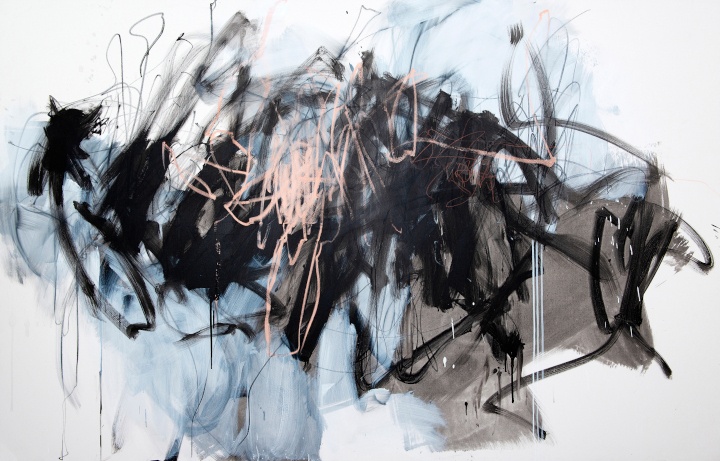
If you had to single out one of Jung’s ideas that guides you most closely in your creative process, which would it be and why?
“Man is always an individual, but not always himself.”
87. G. Jung, C. G. Jung Speaking: Interviews and Encounters, p. 87.
Who are we, truly? Not what we are, but who we are? What stands behind everything? How much are we truly ourselves, and what do we see when we look inside?
Behind every action what we do, say, even think, there is always something more of which we are not conscious. We are often so certain it does not exist that we never question it. And yet that “something more” is actually us. That is what I try to reach and to express visually.
The series Conflict is one way of exploring this.
What is it that carries everything else? Painting gives that possibility a form.
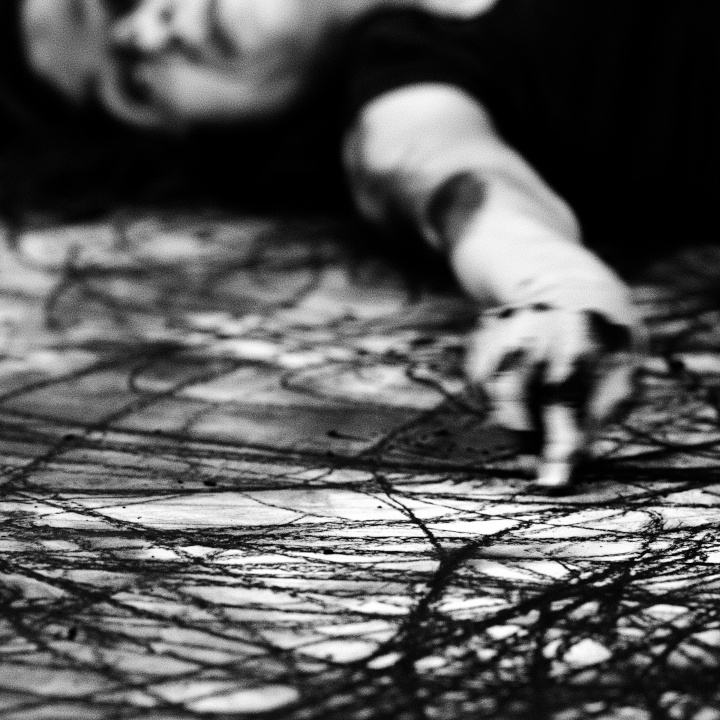
How long did the performance of Kinetic Drawing envolve, and how would you describe that experience — as a dialogue between body, line, and the energy that shapes space?
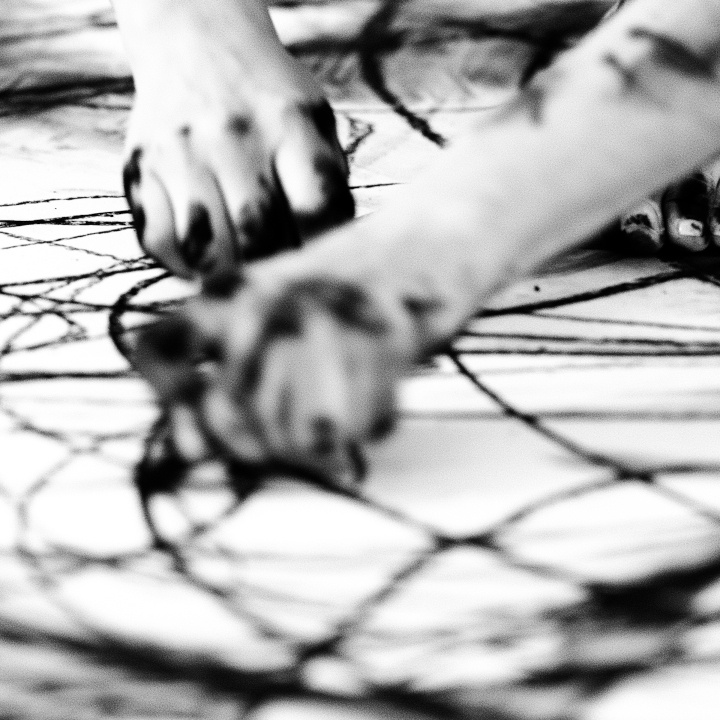
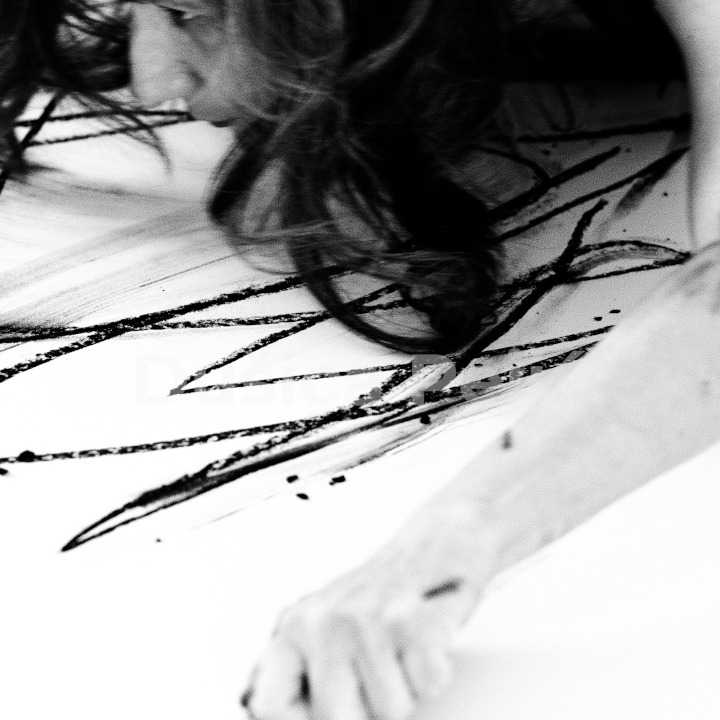
The performance of Kinetic Drawing, although different from painting in form, is deeply connected to it conceptually and psychologically. All my experiences, drawing, painting, ballet, fencing, once seemed unrelated, yet they had a much deeper impact than I was aware of. My engagement at the Belgrade Dance Institute brought inspiring work with young professional dancers, where my interest in visual work and movement naturally merged into something that was ready to happen, the Kinetic Drawing performance.
It is a visual documentation of movement in which the boundaries between movement and visual art, body and line, dissolve. The performance carries a deep archetype within it. The drawing emerges through intuitive, improvised movement of the unconscious, uncontrolled. As such, it carries both the personal and the collective unconscious.
The trace I leave behind on the surface across which with my body moves may reflect the archetype active in my unconscious at that moment. The very process of creating a Kinetic Drawing contains something ritualistic. My preparation, the focus on my own body, the release of control, all of that is itself an archetype.
Your exhibition Conflict was presented in February at the Sales Art Gallery Belgrade in Belgrade — a space that for decades has gathered contemporary artistic voices and opened dialogue between artist and viewer. Through this exhibition you explored the layered theme of inner and outer tensions, exploring conflict not only as opposition but as a driving force of transformation and self-knowledge. How did this exhibition come into being, and what impulses shaped its concept?
What is strongest is what is authentic. Not original, because originality in professional art does not truly exist, but authentic. And authenticity is what we have lived and carry within ourselves.
The work on the series Conflict began as a process I was going through personally. There is no other way to explore something without entering it yourself. Yet this is not about presenting my personal conflicts. They are merely the material, the starting point that allows me to open a deeper experience and awareness. As much as someone is moved by my painting, in any way, I have succeeded in that intention.
To be in more direct, authentic contact with myself, I must enter inward. To search for “what lies behind.” To descend into that space of the unconscious. In order to bring that onto the canvas as directly as possible, as much as I am capable, it is important for me to control the process as little as possible. I paint with the opposite hand from the one I normally use. At first it was unusual, but also interesting and useful. Forms appear that I did not consciously plan. Distance is also important, as it means less control with more physical and mental distance. I tie brushes to long sticks to create additional distance and reduce control.
You shape your painterly expression through large formats. Reveal the secret of the large form.
Large format feels completely natural and close to me. My professor Milan Blanuša was very important in this, confronting us with the meaning of a large surface, what it is and why it matters.
Although I appear calm, composed, and introverted, I carry a strong energy that longs for movement, gesture, and space. If there is a secret behind it, it is simply a great creative force.
It is an extraordinary feeling to stand before such a large surface. I have no fear of emptiness, only impatience and a powerful sensation of the first stroke. Fear exists only when our intention is unclear and when we are afraid of making a mistake. The moment we accept that a mistake is not a mistake, but an essential part of what we carry within, fear disappears.
The March issue of RYL Magazine carries the theme “My New Era.” How do you see your new phase, the new era that is beginning in everything?
I see it as serious, deep, far-reaching. Not as the beginning of something new, but as a deepening and a discovery of what has always been there. That space of awareness is in fact a space of freedom, and with it comes a greater responsibility toward what has been given to me and what I carry within.